Showing posts with label Coming-of-age. Show all posts

16 October 2012

Book Review: Pessoas Como Nós (Folk Som Vi) [People Like Us]— Margarida Rebelo Pinto

All that glitters isn't gold...


[den svenska översättningen finns lite längre ner i inlägget]

SUMMARY:
Not all men have hearts, but then again neither do all women. What could drive two sisters apart? How do you lose a great friendship? Three women  shrouded with loneliness tell their stories and end up revealing the most shocking secrets. Maria do Carmo is no what she seems, Verónica discovers something unthinkable and Julieta carries the baggage of a violent and sordid trauma. After all, everyone is normal until we know them better.

This is a clumsy comtemporary novel that tells about three well off women in their late thirties. The book is divided into 16 chapters, where each woman gets an average of 3 chapters to ruminate about their miserable lives. What follows are 5 chapters which from the point of views of five different macho men, where they dish out the dirt about their experiences with the abovementioned women (two of Verónica’s exes and her gay best friend, Julieta’s most recent ex, and Maria do Carmo’s soon to be ex-husband) and lastly we get a conclusive chapter from Verónica’s perspective. Even though Juilieta inaugurates the novel, the reader soon understands that the real main character is Verónica.

I will now answer the teaser questions found on the blurb on the book: [SPOILER] Maria do Carmo hates her baby sister Julieta because she is beautiful and therefore her father’s favorite, so she has always bullied her sister. Julia sleeps with her best friend’s first love— a guy that Verónica dumped 15 years before. Maria do Carmo is lesbian, Verónica discovers that her parent’s iconic marriage is a lie seeing as her dad is gay. And finally, Julieta has been sexually assaulted by her father. 

REVIEW:
This book burst my bubble of the beautiful and lyrical Portuguese literature. In theory, I knew that there were many shitty books out there written by Portuguese authors, but I never thought I’d stumble upon one in real life— but now that it’s happened let me explain why this book sucks donkey balls:

I’ll start with title— “People like us” in connection with the blurb “people are always normal until we know better” sounded like Rebelo Pinto was telling stories of ordinary people and their ordinary, but interesting problems. But no, after finishing the book, I understand that with “people like us” she means people of the same social sphere as the author herself— i.e. Portugal’s social and cultural elite. This book turns out to be an attempt to explain that the rich, despite their outwardly perfect lives, really do have problems too! I have nothing against the rich, or tales about rich people per se, but this book in particular manages to only deal in clichés. Rebelo Pinto writes about daily visits to expensive restaurants (one of the places Verónica goes to charges EUR 35 for a quiche appetizer!— my friend and I almost died when we say the prices as we walked by that restaurant one time), women that spend hours at the gym and chauffeurs that pick their children up from (the expensive American) school, like that sort of lifestyle was normal for the average Portuguese family— and, having lived in Lisbon and being familiar with how hard a middle class family has to work, that annoys me to no end.

Pessoas Como Nós feels like a filler novel: Rebelo Pinto’s main objective was probably to write about Verónica. But then at the end she realized that it wasn’t enough for a whole book, so she stuffed the tale with other characters that had a remote connection with Verónica’s life like Julieta and her sister Maria do Carmo and the ex-boyfriends just to meet the page count. The form feels clumsy, and I get the feeling that the book is unfinished and need to be reworked. It feels like Rebelo Pinto got tired of here own story after the 9th chapter, since that’s when the sporadic chapters from the men’s pov come in and drag this story further down the drain. As a reader I did not give two cents about Gabriel, Fred etc, I did not pick up the book to read about them.

I was also not pleased with Rebelo Pinto’s style. Too much swearing and mysogenistic thoughts. Too much of the stereotypical macho culture. Her style made every character (especially the men) out to be immature and pathetic.

The characters were also half-assed. Verónica, the main character, is a boring good two-shoes with a perfect life. I found it extremely hard to sympathise with her since she didn’t really have any problems, so what she did was create relationship problems just to have something to bitch about. She’s the irritating, and self-centered person I’ve read about in a long while. I’d be very disappointed with myself if as a 37-year old, I’d be defining my life in terms of my relationships with men— I would argue that by 37  one would have experienced a large chunk of life, and it shouldn’t be a big deal that Mr. Right still hasn’t come along since someone like Verónica would have a career, good friends, family, a house and a pile of money as a measure of achievement. Verónica reminds me of Fiona from the book Prep— some one who I also thought was an idiot.

Then we have Julia, the one I liked the most about the tree women. She had a greater depth character than Verónica, but the author refused to let the reader spend more time with her. She is a sympathetic woman who has had a hard life and as a result is depressed. What I like about Julia is that she mulls over a variety of things that have influenced her life: from her romantic relationships to how to have a better relationship with her teenage son, what she is going to do in a few years when she’s too old to play the leading lady, why she has a huge house that she hates and only cost her a lot of money? Why she is bad at giving her maid proper direction, etc. It feels like Julieta has a life— an inner life, granted she spends most of her free days watching TV on anti-depressants.

Unfortunately, Maria do Carmo is a flat bitchy character that exists just to show that Julieta’s childhood was hell on earth and to strengthen negative stereotypes about lesbian women. The author seems to go with the following premises: you became a lesbian because one’s father’s abusive behavior. On top of that a lesbian is fat, ugly and jealous of other women. I really wish that the author had put more effort into this character, her inner conflicts as a lesbian woman that herself forced by society to marry a man and get children had a lot of potential, but the author didn’t even bother to write about it. Instead she tells about how Maria do Carmo one time lures the class playboy by pretending to want to give him head only to end up biting his member as revenge for his being a player! *sigh*


Well, suffice to say that I wasn’t impressed. The worst part is that this was not a satire, this book take itself very seriously. This isn’t something I’d recommend as good reading. 

OMDÖME:
Det här var den första av mina Tre på Tre böcker— september boken alltså. Pessoas Como Nós sprack min bubbla om den fina lyriska Portugisiska litteraturen. I teorin visste jag ju att det fanns många dåliga böcker av portugisiska författare, men trodde aldrig att jag skulle råka på en i praktiken— men nu har det hänt. Den här boken är inget för mig, och jag vill förklara varför: 

Jag börjar med titeln— ”Folk som vi” i sammaband med baksidestexten ”folk är alltid normala tills vi vet bättre” lät det som att Rebelo Pinto skulle skriva om vanliga människor och sina vanliga, men intressanta problem. Men nej, efter att ha läst boken förstår man att med ”folk som vi” menar hon nog den sociala skaran hon själv tillhör— Portugals sociala elit. Den här boken visar sig vara ett försök att förklara att de rika, som ser ut att ha perfekta liv, minsann har problem de också! Jag har inget emot de rika, eller berättelser om rika människor i sig, men just den här boken lyckas bara förmedla klichéer. Rebelo Pinto skriver om dagliga besök på dyra restauranger (en av restaurangerna som Verónica besöker tar €35 för en quicheliknande förät!— jag och min kompis fick nästan hjärtattacker efter att ha kollat in priserna när vi gick förbi en gång), kvinnor som spenderar flera timmar på gymmet och chaufförer som hämtar upp barnen från (den dyra amerikanska) skolan, som om det vore vanligt hos vilken Portugisisk familj som helst— och det irriterar mig som har bott och arbetat i Lissabon och sett hur hårt en medelklassfamilj måste jobba.

Pessas Como Nós känns som en fillerroman: Rebelo Pinto främsta avsikt var nog att skriva om Verónica, men det visade sig att Verónicas historia inte räckte till en hel bok, så hon fick stoppa in andra karaktärer som har en vag koppling till Verónicas liv som Julia och hennes syster Maria do Carmo och ex-pojkvännerna för att fylla sidorna. Formen känns klumpig, jag får en känsla av att boken är ofärdig och behöver bearbetas. Det känns som om Rebelo Pinto tröttnade på sin egen berättelse efter det 9de kapitelet. För efter det börjar man helt plötsligt få sporadiska kaptitel ur männens perspektiv som inte alls lyfter upp handlingen. Som läsare brydde jag mig inte alls om Gabriel, Fred etc, jag var inte där för att läsa om dem. 

Jag var inte heller förtjust i Rebelo Pintos skrivsätt, det var för mycket svordomar och kvinnofientliga tankegångar; för mycket av den stereotypiska machokulturen. Skrivsättet gjorde att nästan alla karaktärer (och speciellt männen) framstod som omogna och patetiska.  

Karaktärerna var också halvdana. Verónica som är huvudpersonen är en tråkig Goody Two-Shoes med ett perfekt liv. Det är svårt att sympatisera med henne eftersom hon inte har riktiga problem, hon skapar relationsproblemen bara för att ha något att gnälla över känns det som. Jag tycker att hon är den mest tjatiga, själv upptagna person jag läst om på länge. Jag skulle bli jätte besviken på mig själv om jag som 37-åring definierar mitt liv i termer av vilka kärleksrelationer jag haft— en 37 årig person har hunnit med ganska mycket i livet och att man inte har hittat Mr. Right bör inte vara en sådan stor grej när man har karriär, många vänner, familj, hus och förmögenhet skulle jag vilja påstå. Verónica fick mig att tänka på Fiona i boken Prep—som jag också tyckte var en idiot. 

Sedan har vi Julia, den jag gillade mest av de tre kvinnorna. Hon har ett större djup än Verónica, men författaren vägrar låta läsaren spendera mer tid med henne. Hon är en sympatisk kvinna som har haft ett hårt liv, och är deprimerad på grund av det. Det jag gillar med Julia är att hon reflekterar över en variation av saker som påverkar hennes liv och inte bara kärleksrelationerna som hon haft: hur ska hon komma närmare sin tonåriga son, vad ska hon göra om några år när hon blir för gammal för att fortsätta vara den vackra skådespelerskan, varför har hon ett sådant stort hus som hon inte ens gillar? Varför är hon så dålig på att ge order till sin hushållerska? Etc. Det känns som att Julia har ett liv, även om hon spenderar sina lediga dagar framför Tv:n neddrogad med anti-depressiva tabletter.
  
Tyvärr är Maria do Carmo en platt bitchig karaktär som existerar bara för att göra Juilas barndom ett helvete och för att förstärka den negativa stereotypen av lesbiska kvinnor: man blir lesbisk för att ens far misshandlar en och därför hatar man män, och så är man fet, ful, och svartsjuk på andra kvinnor. Jag önskar verkligen att författaren hade ansträngt sig mer med den här karaktären, hennes inre konflikter som lesbisk kvinna som kände sig tvingad att gifta sig med en man och skaffa barn hade potential, men författaren bryr sig inte ens om att skriva om det. Istället berättar hon om hur Maria do Carmo en gång lotsas suga av en playboy till klass kamrat för att bita hans kuk som straff för att han var en kvinnokarl.  *suck* 

Inte alls imponerande. Det värsta är ju att det inte är en satirisk bok, utan att den tar sig själv på stort allvar. Näää, det här är inget jag skulle rekommendera som bra läsning.

Liknade Bättre Böcker:

4 August 2012

Audiobook review: Matched & Crossed -- Ally Condie

[den svenska översättningen finns lite längre ner i inlägget]

SUMMARY:

Cassia has always trusted the Society to make the right choices for her: what to read, what to watch, what to believe. So when Xander's face appears on-screen at her Matching ceremony, Cassia knows with complete certainty that he is her ideal mate... until she sees Ky Markham's face flash for an instant before the screen fades to black.

The Society tells her it's a glitch, a rare malfunction, and that she should focus on the happy life she's destined to lead with Xander. But Cassia can't stop thinking about Ky, and as they slowly fall in love, Cassia begins to doubt the Society's infallibility and is faced with an impossible choice: between Xander and Ky, between the only life she's known and a path that no one else has dared to follow. —Goodreads

REVIEW:
I was really skeptical about this book— I thought it would be one of those books where the girl's sole purpose in life is to find out who she really really belongs with, so it took a long time before I even dared to spend one of my audible credits on it ... but God, I was amazed!

I read The Giver in middle school, and loved it! Some reviewers complained that Matched is a rip-off of The Giver, but I see Matched as a positive mix of The Giver and Brave New World with a teenage twist. Anyway, that’s not what really what made fall for Matched.

I loved Cassia! Okay, I must admit I do not really know if it's Ally Condies portrayal of her or Kate Simses amazing rendition that makes Cassia so gracious ... maybe it's a combination of both? Condie shows us a girl who talks about her experiences in a warm, sober, humble and very natural way (a stark contrast to Amy in Across the Universe). She’s also naïve and rebellious. Simses’ voice Cassia fits perfectly! She really sounds like a seventeen year old, her voice is so authentic that it really feels like it's Cassia talking to me.

I had a lot of prejudice against the book and thought it would be a teenage romance a la Twilight. But instead, I experienced the book as a classic coming-of-age story. Cassia is becoming an adult, and she discovers gradually that her society is not perfect and that she must learn to think in a nuanced way (everything is not right or wrong).

The society in Matched is not so stifling such as in The Giver and Brave New World, you notice that people find tiny loopholes to the rules now and then, like when [SPOILER] Cassia’s father destroys her grandfather’s test tube, and how her grandfather had a few banned poems left. Additionally Condie explains how the Society has gained so much power and control over all: censorship and a strict division of labor makes you dependent on the Society as the overall coordinator (eg you don’t cook your food yourself, and those who decide the menu aren’t the ones making the food, those who make the food have no contact with those who wash dishes, and the people who sort dishwashers are professional sorters who don’t work in the “dishwashing industry”.

But there was one thing (permission to roll your eyes) that bothered me, and now I sound like a bitch but I can’t help it— the book is written in present tense. It's irritating that all  YA books are written that way! I know that the authors want to make me believe that everything that happens in the book is, like, imminent ... but it just does not work for me-I like the past tense and want stories to be written in the past tense. *Humph* -_-

OMDÖME:
Jag var jätteskeptisk mot den här boken—jag trodde att det skulle vara en sådan bok där tjejens enda quest för att ta reda på vem hon verkligen egentligen hör ihop med— så det tog en lång tid innan jag ens vågade spendera en av mina audible credits på den… men Gud vad jag blev överaskad!

Jag läste The Giver i högstadiet, och älskade den! Jag har läst några recensioner av folk som klagar på att Matched är en rip-off av The Giver, men jag ser Matched som en positiv sammanmältning av The Giver och Brave New World med en tonårs-twist. I alla fall, är det inte det som verkligen fick mig att falla för Matched:

Jag älskade Cassia! Okej, jag måste erkänna att jag inte riktigt vet om det är Ally Condies porträttering av henne eller Kate Simses fantastiska uppläsning som gör Cassia så älskvärd… det kanske är en kombination av båda? Condie visar oss en tjej som berättar om sina uppleverser på ett varmt, sansat, ödmjukt och väldigt naturligt sätt (en stark kontrast till Amy i Across the Universe). Naiv och busig är hon också. Simses röst passar Cassia perfekt! Hon låter verkligen som en sjuttonåring, rösten är så äkta att det känns verkligen som det är Cassia som pratar med mig.

Jag hade en massa fördomar mot boken och trodde att det skulle vara en tonårsroman à la Twilight. Men istället upplevde jag boken som en klassisk coming-of-age story. Cassia håller på att bli vuxen; och hon upptäcker gradvis att hennes samhälle inte är perfekt och att hon måste lära sig att tänka på ett nyanserat sätt (allt är inte rätt eller fel).

Samhället i Matched är inte så kävande som t.ex. i The Giver och Brave New World, man märker att folk går om reglerna då och då som när [SPOILER] Cassias pappa förstör henne farfars cellprov, och hennes farfar hade några förbjudna dikter kvar. Dessutom Condie förklarar hur The Society har fått så mycket makt och kontroll över alla: censur och en strikt uppdelning arbetsuppgifter som gör att man blir beroende på The Society som den övergripande koordinatorn (t.ex. man lagar inte maten själv, och de som bestämmer menyn är inte desamma som lagar maten, de som lagar maten har ingen kontakt med de som diskar, de som sorterar de bästa diskare är sorterare och jobbar inte specifikt inom ”diskningsindustrin”, etc.). 

Men det var en sak (här får ni lov att himla med ögonen) som störde mig: och nu ska jag låta som en kärring men jag kan inte låta bli— boken är skriven i presens tempus. Det är för jävligt alla YA-böcker som skrivs på det sättet! Jag vet att författarna vill få mig att tro att allt som händer i boken är, typ, överhängande… men det funkar bara inte för mig— jag gillar imperfekt och vill att berättelser ska skrivas i imperfekt tempus. *humph!* -_-

Other Reveiws of the Same Book/ Bloggat om Samma Bok
________________________________________________________________________________________________________

SUMMARY:

Rules Are Different Outside The Society

Chasing down an uncertain future, Cassia makes her way to the Outer Provinces in pursuit of Ky--taken by the Society to his sure death--only to find that he has escaped into the majestic, but treacherous, canyons. On this wild frontier are glimmers of a different life and the enthralling promise of a rebellion. But even as Cassia sacrifices every thing to reunite with Ky, ingenious surprises from Xander may change the game once again.
Narrated from both Cassia's and Ky's point of view, this hotly anticipated sequel to Matched will take them both to the edge of Society, where nothing is as expected and crosses and double crosses make their path more twisted than ever.—Goodreads

REVIEW:
I am, apparently one that likes books where nothing happens (there are many books, anime, manga and movies where nothing super exciting happens that I love), because this book was an alright read for me ... It was not as good as Matched but it was not bad either. Anna from Boktycke is an apt description of the book: a well-written “transportation book”.


Cozy Cassia is back and she has become more hardened, more daring and sometimes even foolhardy, but this time she had to share her story with Ky. They are apart most of the book, which I feel is very positive. I like Ky much better now when you find out his frustrations, and skepticism toward freedom from the Society balances Cassia eagerness for The Rising in a good way. Often it so that characters in dystopias are confident that everything will resolve itself after the revolt / liberation ... and many authors writing dystopias equate "liberation" with a happily ever after instead of the chaotic beginnings that liberation movements tend to be IRL (eg Arab Spring).

Crossed raises many questions about The Outer Provinces: what's really going on there? [SPOILER] Why send the women and children there? Why should they be decoys? Who are they fighting against? Or is it that perhaps there is no Enemy, and The Society has just invented a war? If so, why? Is it because the resources are running out? Many questions, no answers! Hopefully all will be revealed in the next book. I do not think the The Rising is so very interesting, however, it’s probably also a corrupt organization.

Xander was in Crossed in spiritual form, and I have read that many like him better after reading this book. Unfortunately I will never be in the "Team Xander": he's too nice to be a young woman's first love. I certainly understand why Cassia is attracted Ky, although I think their romance is such a romance that will not last in the long run. Xander is probably the guy you meet after a youthful, tumultuous relationship. And Cassia is not thirty yet.


I'm not as impressed by Jack Riccobonos voice acting, he is good but unfortunately he’s got nothing on Kate Simses.


OMDÖME:
Tydligen är jag en sådan som gillar böcker där ingenting händer (det finns många böcker, anime, manga och filmer där inget fartfylld och spännande händer som jag älskar), för den här boken var helt okej för mig… Den var inte lika bra som Matched, men den var inte dålig heller.  Anna från Boktycke har en passande beskrivning av boken: en välskriven transportsträcka. 

Mysiga Cassia är tillbaka— och hon har blivit mer härdad, modigare och ibland ganska dumdristig— fast den här gången måste hon dela sin berättelse med Ky. De är ifrån varandra mestadels av boken, något som jag upplever som väldigt positivt. Jag gillar Ky mycket bättre nu när man får reda på hans frustationer; och has skepsis till att frigöra sig från The Society balanserar Cassias ivrighet om The Rising på ett bra sätt. Ofta är det så att karaktärer i dystopier är övertygade att allt ska lösa sig efter revolten/ frigörelsen... och många författare som skriver dystopier liknar ”frigörelsen” med att alla förblir lyckliga i alla sina dagar istället som den kaotiska början som frigörelserörelser brukar vara IRL (eg. Arabiska våren).

Crossed väcker många frågor om The Outer Provinces: vad är det som egentligen pågår där? [SPOILER]Varför skickar de barn och kvinnor dit? Varför ska de vara decoys? Vem krigar de emot? Eller är det kanske så att det inte finns någon Enemy, och att The Society har bara hittat på ett krig? I so fall varför? Är det för att resurserna håller på att ta slut? Många frågor, inga svar! Förhoppningsvis kommer allt att avslöjas i nästa bok.  Jag tycker inte att the The Rising är så väldigt intressanta dock, förmodligen är det också en korrupt organisation.

Xander var med i Crossed i andlig form, och jag har läst att många tycker bättre om honom efter att ha läst den här boken. Tyvärr kommer jag aldrig att vara i ”team Xander”: han är alldeles för snäll för att vara en ung kvinnas första kärlek. Jag förstår verkligen varför Cassia är attraherad av Ky, även om jag tror att deras romans är en sådan romans som inte kommer att hålla i längden. Xander är väl den killen man träffar efter en ungdomlig, tumultartad förhållande. Och Cassia är inte trettio ännu.  Näää… nu får jag avsluta mina tantiga betraktelser!

Jag är inte lika imponerad av Jack Riccobonos röstskådespeleri, han är bra men tyvärr han är i skuggan av Kate Simses.

Other Reviews of the Same Book/ Bloggat om Samma Bok:
________________________________________________________________________________________________________
Liknande Böker:


28 July 2012

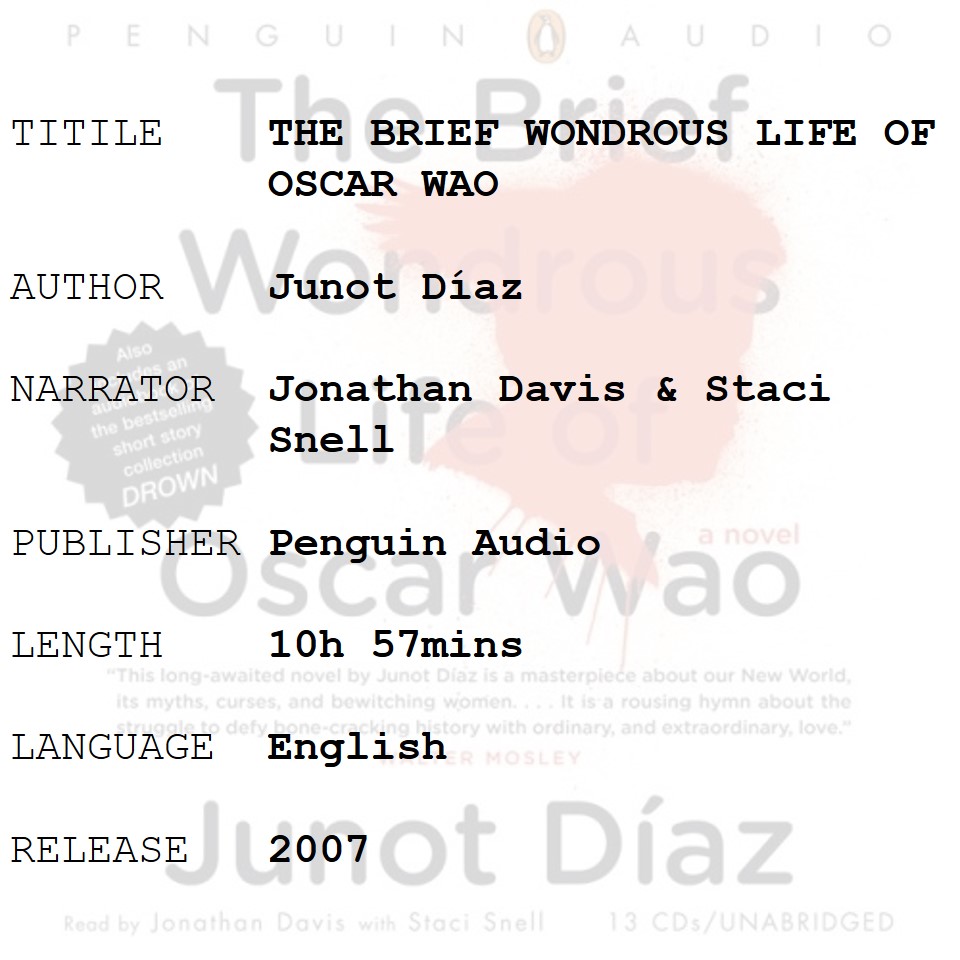
Audiobook Review: The Brief and Wondrous Life of Oscar Wao – Junot Díaz

[den svenska översättningen finns längre ner i inlägget]

SUMMARY:
Oscar is a sweet but disastrously overweight ghetto nerd who--from the New Jersey home he shares with his old world mother and rebellious sister--dreams of becoming the Dominican J.R.R. Tolkien and, most of all, finding love. But Oscar may never get what he wants. Blame the fuku--a curse that has haunted Oscar's family for generations, following them on their epic journey from Santo Domingo to the USA. Encapsulating Dominican-American history, "The Brief Wondrous Life of Oscar Wao" opens our eyes to an astonishing vision of the contemporary American experience and explores the endless human capacity to persevere--and risk it all--in the name of love. Insert text— Adlibris

REVIEW:
This book has three things I love: brilliant prose, magical realism, and cultural clashes.

What great prose! It’s not often that I read/listen to a book just because of the prose (usually the story has to be plot driven for me to continue reading it). It is noticeable at Diaz's super nerdy and that he has a lot of knowledge about Dominican history and Trujillo's dictatorship. The book is crammed with historical and pop culture references! But it doesn’t feel like Diaz is trying to force all the facts on the reader: he integrates story and facts in such a seamlessly empathic way.

I can understand that this book can be a difficult read for someone who does not understand Spanish, since Diaz uses a lot of "Spanglish" slang ... but, I find that it is precisely this that makes the book feel “real” since it’s about a ghetto-nerd.

I’ve also read many comments that the footnotes in books are distracting. I’m not of that opinion though, and since I was listening to the book the information on the footnotes felt like a cohesive part of the story... so maybe this is a book that works better as an audio book than as a regular book? I really liked the way the readers narrated the book, Jonathan Davis in particular.

Diaz uses magical realism in the way only Latin American writers can. The story revolves, as I said, around a Fuku (a curse) that is inherited, which means that he unravels a family's history, traditions and psychology. So making the book very emotionally engaging. Personally, I really love stories of exotic multicultural societies where the supernatural meanders into everyday life! Maybe it's because I've spent my first 10 years in a society that is similar to the one Diaz describes, in Mozambique.


I’m also extremely partial to books about i/emigrants, and Diaz writes with a lot of insight about the de Léon family, who have one foot in the U.S. and one foot in the Dominican culture and how that creates entropy within the characters. He does a realistic portrayal people who cannot feel “whole” when their “other” culture are still in the background. This is the reason for Oscar’s depressions, Lola’s uprising and Belicia’s bitterness.

OMDÖME:
Den här boken har tre saker som jag älskar: lysande prosa, magisk realism, och kulturkrockar.

Vilken bra prosa!!! Det händer inte ofta att jag lyssnar på en bok bara pga prosan (normalt är det handlingen som får mig att fortsätta läsa en bok). Det märks at Diaz är sjukt nördig och att han har hur mycket kunskap som helst om Dominikansk historia och Trujillos diktatur. Boken är fullproppad med historiska och popkultursreferenser!  Men det känns inte som om Diaz försöker tvinga all denna fakta på läsaren; han lindar berättelse och fakta på ett naturligt sätt med mycket inlevelse.

Å andra sidan kan jag förstå att den här boken kan vara svårläst för någon som inte förstår spanska, eftersom Diaz använder mycket ”spanglish” slang… själv, tycker jag att det är just detta som får boken att kännas ”real”, boken handlar ju om en ghetto-nörd. 

Jag har också läst många kommenterer om att fotnoterna i boken är jobbiga. Jag tyckte inte det, eftersom jag lyssnade på boken, vilket gör att infot på fotnoterna känns som en sammanhängande del av berättelsen… kanske är detta en bok som funkar bättre som ljudbok än som läsebok? Jag tycket väldigt mycket om sättet uppläsarna läste upp boken, speciellt Jonathan Davis.

Diaz använder sig av magisk realism på det sättet som bara latinamerikanska författare kan. Berättelsen kretsar, som sagt, kring en fukú (en förbannelse) som går i arv vilket innebär att man rotar i en familjs historia, traditioner, och psykologi. Pga det blir boken väldigt känslosam. Berättelser om exotiska multikulturella samhällen där det övernaturliga slingrar sig in i vardagslivet gillar jag djupt! Kanske är det för att jag har spenderat mina första 10 år i en sådan miljö, i Mocambique.

Jag känner också för böcker om in- och-utvandrare, och Diaz skriver mycket insiktfullt om familjen de Léon som har en fot i den Amerikanska och en fot i den Dominikanska kulturen och hur detta skapar entropi inom karaktärerna. Han skriver väldigt realistiskt om känslan av att aldrig känna sig ”hel” som människa när ens ”andra” kulturella jag spökar i bakgrunden. Detta är orsaken till Oscars depressioner, Lolas uppror och Belicias bitterhet. 

Bloggat om Samma Bok:
-------------------------------------------------------------------------------------------------------------------------------------------------------------------------------------
Liknade Böcker: